A Cover Version Of A Car?
I’d made the decision. The time was right. I had a little bit of money of my own and I’d managed to raise more by roping in a couple of folks – family and friends – in what would be “potentially the worst investment they’d ever make.” My friend Denholm Harding, easily the most gifted, experienced and mature muso I know, had agreed to produce it for me. The deposit for the recording studio had been paid and the most important project of my musical career thus far, my debut original music album, was mere days away.
We knew the when, the where, the why and the how. The who (would play and sing) would work itself out as we went along but Den’s insane multi-instrumentalist talents would cover loads of bases. The what was the question. I had, over the years, built up a modest catalogue of original songs but I wanted to add a cover. But which one? And perhaps more importantly, why and how that particular song?
Cover versions divide people. “If it ain’t broke, don’t fix it,” the glass-half-empty-ers would say. And there’s merit in that argument. There’s a good reason Bohemian Rhapsody and Stairway To Heaven have been so seldom (successfully) covered. Some songs are so perfectly crafted and make such a massive initial impact, that regardless of the levels of talent of the potential cover-er, they just don’t see a way of making the song better. Or at the very least, of retaining the song's magic after they’ve waved their wand.
I’ve always thought that a cover version should be a shakeup. I’ve never seen the point in a carbon copy of the original. Surely, your individual take on a classic – 'making it your own,' reality talent shows have called it – is a better doff of the cap than straight-up repetition. The problem with that concept, however, is that you run the risk of alienating the die-hards. Still, nothing ventured,…
And so, my producer and I settled on a 70s folk classic made famous by Don McLean. His wonderful tribute to van Gogh has always held a special place in my heart. As I grew older and life happened, my mental health got punched in the face. Treatment, group therapies, nutritional maturity and physical fitness helped keep me from spiralling (they still do). Medication played a part. It still does. But my new mental health diagnosis gave me a different outlook on Mclean’s Vincent. For me, for my version of it, the song needed to echo the inky blackness of depression. Our effort needed to reflect, in its arrangement, its sonic values and its overall theme, the incredibly ominous, sinister place untreated depression can take you. The places Vincent van Gogh could not recover from.
Thankfully, not all musicians share my macabre mindset. The majority of the great cover versions are celebrations of song and dance. Of love and life. And of talent and passion. Amy Winehouse and Mark Ronson’s Valerie (The Zutons) is a firecracker, inspired and timeless. Winehouse’s unique, languid, behind-the-beat vocal style and cigar lounge tone, paints class and sophistication on an otherwise frivolous lyric sheet. Stevie Wonder’s We Can Work It Out (The Beetles) is an almost impossible RnB version, building energy and momentum into a song which most would suggest had sufficient levels of both to start with.

Sometimes a great cover version is a study in less, not more. The First Time Ever I Saw Your Face by Roberta Flack can hardly be described as a complex arrangement. Yet it was far too involved for James Blake. His minimalist piano and sensual, intimate vocals expose the piece’s vulnerability to an even greater degree. Eva Cassidy’s Fields Of Gold (Sting) and Gary Jules & Michael Andrews’ take on Tears For Fears’ Mad World are equally haunting in their simplicity.
But can you ‘cover’ a car? The short answer, in my view, is yes. The term restomod is an amalgamation of two words: restore and modernise. I’m not entirely sure when or where the term was first coined but I suspect it has its roots in the hugely healthy American automotive aftermarket sector. Customers grew tired of throwing thousands of dollars restoring their classic muscle cars, only to be asked to continue to live with the unreliability of a 40-year-old, questionably built – even when new – classic car. The answer? Transplant the mechanicals – not just the engine – of a modern car into your classic, and BAM! A restomod. A cover version of a car.
The Porsche 911 could quite easily be described as the Steve McQueen of the sports car and supercar world. It is, absolutely, a study in less being more – a concept musicians learn as they improve. Ferraris and Lamborghinis, in their design, are dramatic, angular and impossibly low and wide. Mechanically, they’re lubricated testosterone, ever-striving to be louder, bigger and more powerful than the last. They shout. They bark. They demand attention. In truth, it can all get a little tiring.
The 911, even in its most dramatic guise – the GT2 RS – when compared to its Italian competitors, presents an altogether rounder, less edgy overall profile. Its engineering excellence does the talking. 911s are a mechanical and design anomaly. Despite a number of inherent sports car don’ts, and very few obvious ‘improvements’ or upgrades to the car as the years have ticked by, Porsche’s flagship product continues to deliver impressive sales figures and offers its owners daily-driver reliability with thoroughbred-crushing performance.
As one would imagine then, the older cars’ monetary value and desirability continue to rise. Remember, the 911 nameplate has survived for nearly 60 years. The Prancing Horse (Ferrari) and The Raging Bull (Lamborghini) build a particular car until they feel it’s outgrown its development (and sales) potential, and they then launch a new one. Porsche has just continued to improve on the one they have. This has resulted in a cult-like following few sports cars can match. The slightly more accessible price tags, even when new, also assist in growing that fan base. At the time of writing, Car And Classic had a red, 1976 911 Targa – the centre panel of the roof can be taken off – for sale for $190 000. That car looks to have been beautifully restored. 20 years ago, that car might have sold for 15% of that price.
But what if, like so many well-heeled car lovers, you’re interested in something more? More than a restoration. And what if even the concept of restomodding your Porsche, just doesn’t ring your bell?
Singer Vehicle Design, based in Southern California is, in my opinion, the world’s greatest exponent of delivering a chart-topping cover version of a car. Their corporate tagline is, “Reimagined.” In building their masterpieces, the 911 DNA is retained but almost every strand is injected with modernity and layered with mouth-watering design detail.
It’s easy to make a car look more aggressive. Lower the suspension, fit bigger wheels with lower-profile tyres and, if you’re going for that full-bore, racing car look, fabricate boxed or bulged fenders over the wheels. The size of the rear wing you bolt onto the boot (or trunk, for the Stars ‘n Stripers) will almost certainly be inversely proportional to the number of libraries you visited as a kid, and directly proportional to the levels of hardtack you consumed before you prefrontal cortex was properly formed.
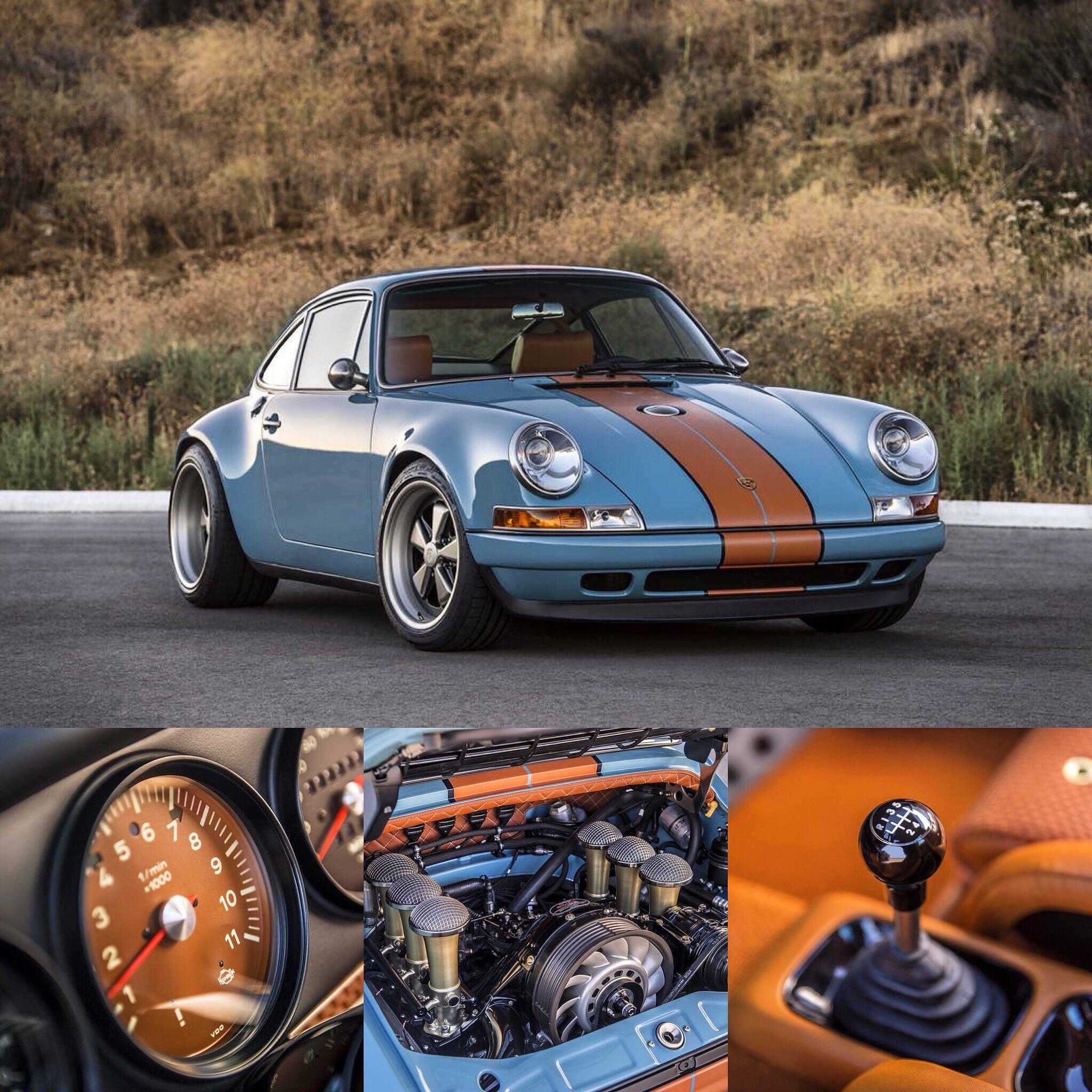
But Singer’s method is to study the original, to understand why every angle, every shape and every shut-line is important. And then they subtly flare or flatten body panels. They gently and perfectly reshape bumpers to better accentuate the corners and the profile. And, as finishing touches, they almost imperceptibly reshape lights, door handles and mirrors. The fuel tank cap is CNC machined from billet alloy and hand-finished. If you found one on a CEO’s oak wood, glass-topped desk, you’d think it was Bauhaus art. Another Singer PR slogan: Everything is important.
Inside the Singer 911, the magic continues. If you thought they’d be content with merely recovering the original seats, replacing the gauges and adding a radio with an MP3 player, you’re reading the wrong article. The highest quality leathers, brushed aluminium, carbon fibre and bespoke cloths are blended to create a space brim-full of jaw-dropping detail. Large, brass finished, hollow studs accentuate suede, alcantara and velour. Cross-panelled straps of padded, riveted leather, replace standard cushions. Even the fuel tank – visible because it's situated under the bonnet (hood) of a 911, is upholstered in Rolls-Royce-rivalling hand-crafted genius. Dash panels, switches and gauges hark back to the simplistic, function-over-form ethos of the original but, under the skin, are modernised with ultra-sophisticated electronics. If the car has black on black interior treatment, the numbers of the tachometer, rev counter and temperature and pressure gauges are coloured an earthy green. If the seats are bright orange alcantara – popping out against a dark blue exterior – the gauges are black but the rev counter is finished in that same, bright, attention-demanding orange hue. The design options, fabric choices and colour combinations seem endless.
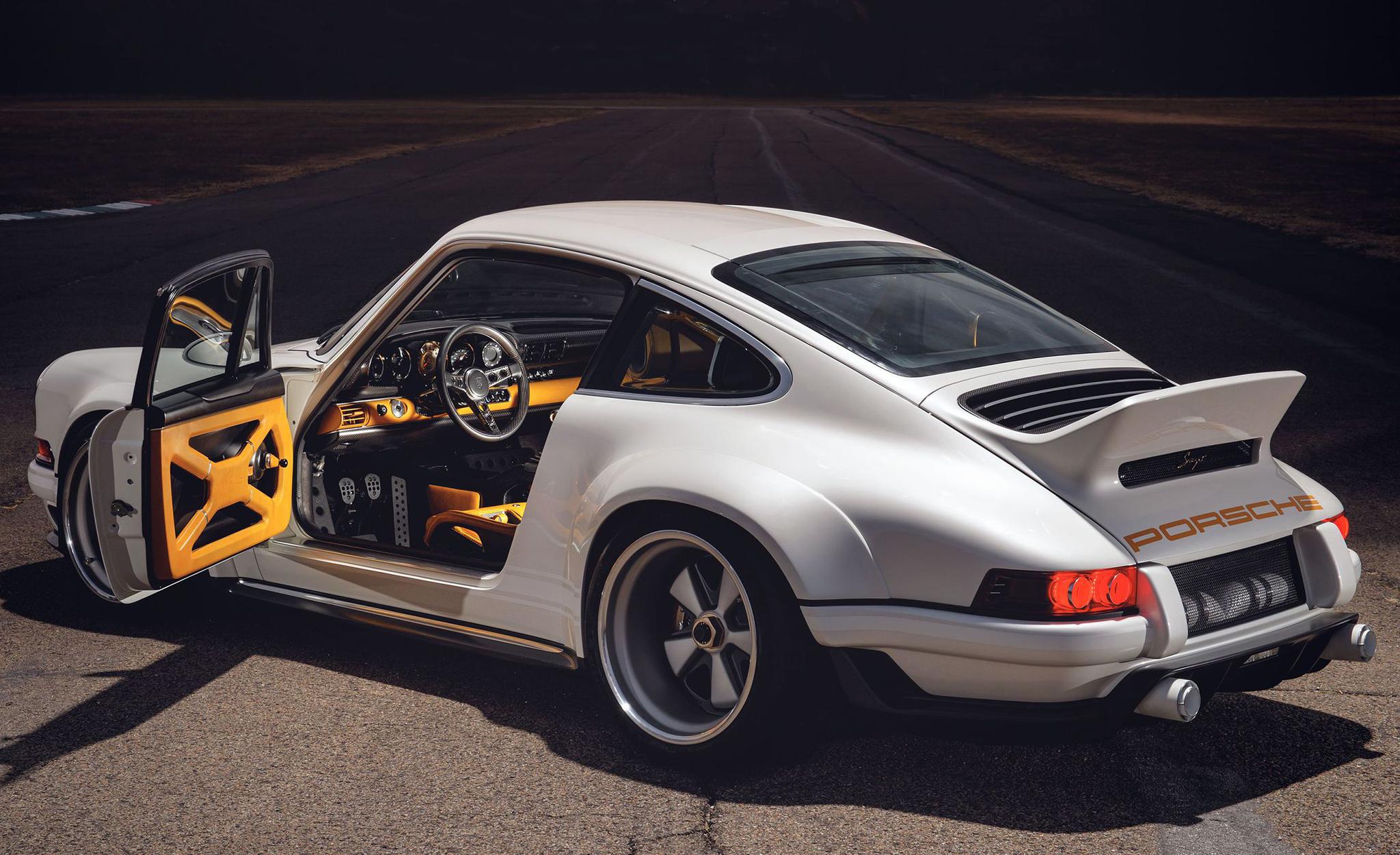
From a mechanical point of view, the tidal wave of revolution accelerates. As a general topic, it’s not difficult to make a car go faster - there are turbo-charging kits to fit any and every engine imaginable. But again, Singer has not only paid homage to the 911’s original air-cooled, flat-6 engine by retaining that basic layout, it has unpacked the blueprints of the very best of those impressive but dated power plants, and found ways to improve on power, fuel economy and reliability. In their very top-spec engine, Singer partnered with Williams Advanced Engineering (yes, the self-same Williams that once dominated F1) to produce a 4.0l, 500hp, air-cooled mechanical marvel. It would take another three pages to even begin to describe why 500hp from an air-cooled, non-turbo engine is flat-out insane. You’re just going to have to trust me on this one.
The result of these tens of thousands of hours of imagineering and conceptualising, and of fabrication and testing and rebuilding, is a car that is dramatically and totally re-worked. To the untrained eye, however, it would probably be described as ‘a cool old Porsche that someone has looked after really well.’
What’s the point of that, I hear you ask. Just as Singer’s design philosophy demands intense and razor-sharp planning and execution from its artisans, a finished Singer 911 demands a lot from us. It asks that we bring our existing understandings and dreams to the table and then allow them to be pollinated, watered, nurtured and reborn.
It will come as no surprise then that a Singer 911 will set you back anywhere between $500k and $1.5mil. And if you put your deposit down now, you’ll be at the end of a 24-month waiting list.
If I’m able to say that the Singer 911 is not only my if-I-won-the-lotto wheels, but also my favourite custom, or restomodded, or cover-version of a car, I’m a little less clear on my favourite song cover.
I’m massively proud of our rendition of Vincent because it’s exactly what I asked Denholm to help me create. His re-harmonizing of the chord structure helped produce a dark, sombre and malevolent wee ditty. What’s this re-harmonizing mumbo-jumbo, you ask. The chord structure in the verses of the original are G, Gsus4, G, Am, C, D, G. Denholm’s mad-cap idea had us starting the intro in Fmaj7 and entering into the verse in Em7. It then goes back to the Fmaj7, to C, then Bm, and back to Em7. And all this without me making a single change the melody of the vocal line. Underpinned by our moody, mist-over-swamp, super-sparse arrangement,… Result.

But it’s probably India.Arie’s Heart Of The Matter (Don Henley) that suctions my fingers toward my Spotify App more often than any other song. I’m guessing that’s because A, I love the original so much and B, Arie’s almost hip-hop flavour in no way assaults the original mood. In fact, its subtly, tastefulness and musicality – and her honey-sweet vocal tone and control – only serve to add an extra layer of warmth and fulfilment. Two songs, very different in their execution, occupying the same emotional space.
But hey, what do I know? I’m just a confused ex muso, wannabe writer, trying to make sense of the cards I’ve been dealt. To quote Mr Henley, via Ms India.Arie, “The more I know, the less I understand. And all the things I thought I figured out, I have to learn again.”
